Paramètres
 Livraison rapide
Les commandes sont généralement livrées en Canada sous 24 heures, selon le lieu de livraison.
 Livraison gratuite
Livraison gratuite vers la Canada pour les commandes de $100 CAD ou plus. Des frais de livraison de $8 CAD seront facturés pour toute commande inférieure à $100 CAD.
 Incoterms
DDP (droits et douanes payés par DigiKey)
 Types de paiement
Compte de crédit pour les institutions et les entreprises qualifiées
Paiement à l'avance par virement bancaire


 Produit marketplace
Plus de produits de partenaires agréés
Délai moyen de livraison de 1-3 jours, des frais d'expédition supplémentaires peuvent s'appliquer. Veuillez consulter la page produit, le panier ou la commande pour plus d'informations sur le statut d'expédition.
Incoterms : CPT (droits, douanes et TVA/taxes applicables exigibles à la livraison)
Pour plus d'informations, consultez la page Aide et support
The LM3450A evaluation board is designed to provide an AC to LED solution for a 30 W LED load. Specifically, it takes an AC mains input and converts it to a constant current output of 700 mA for a series string of 1 to 13 LEDs (maximum LED stack voltage of 45 V). There are two assembly versions designed to operate from two different nominal AC input voltages, 120 VAC or 230 VAC.
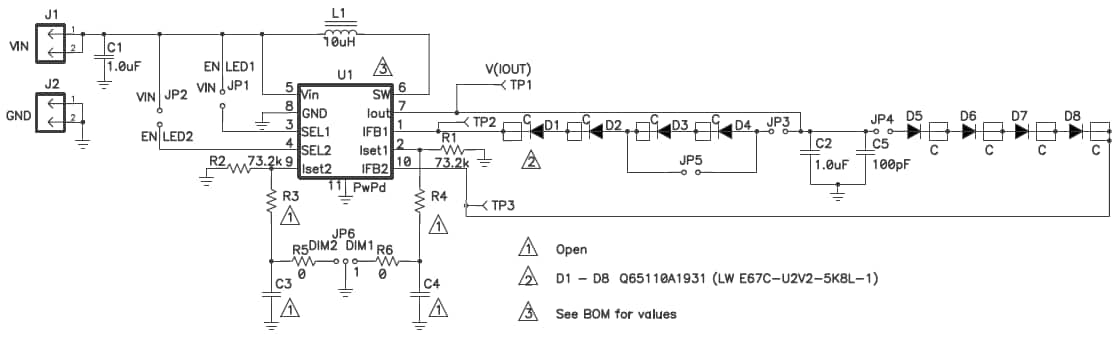
The Texas Instruments TPS61150EVM-150 evaluation module contains the TPS61150 IC. This EVM provides two independently regulated current outputs using a single inductor step-up (boost) converter.
This wide range evaluation board showcases the LM3424 NFET controller used with a buck-boost current regulator. It is designed to drive 4 to 10 LEDs at a maximum average LED current of 1A from a DC input voltage of 10 to 70V.
* For Constant Current, the board must be modified as described on page 8 of the user guide. * Streetlight applications require that the power supply designed to power an LED lamp must have high efficiency and at least an equivalent lifetime in order to guarantee maintenance-free operation during the life of the LED.
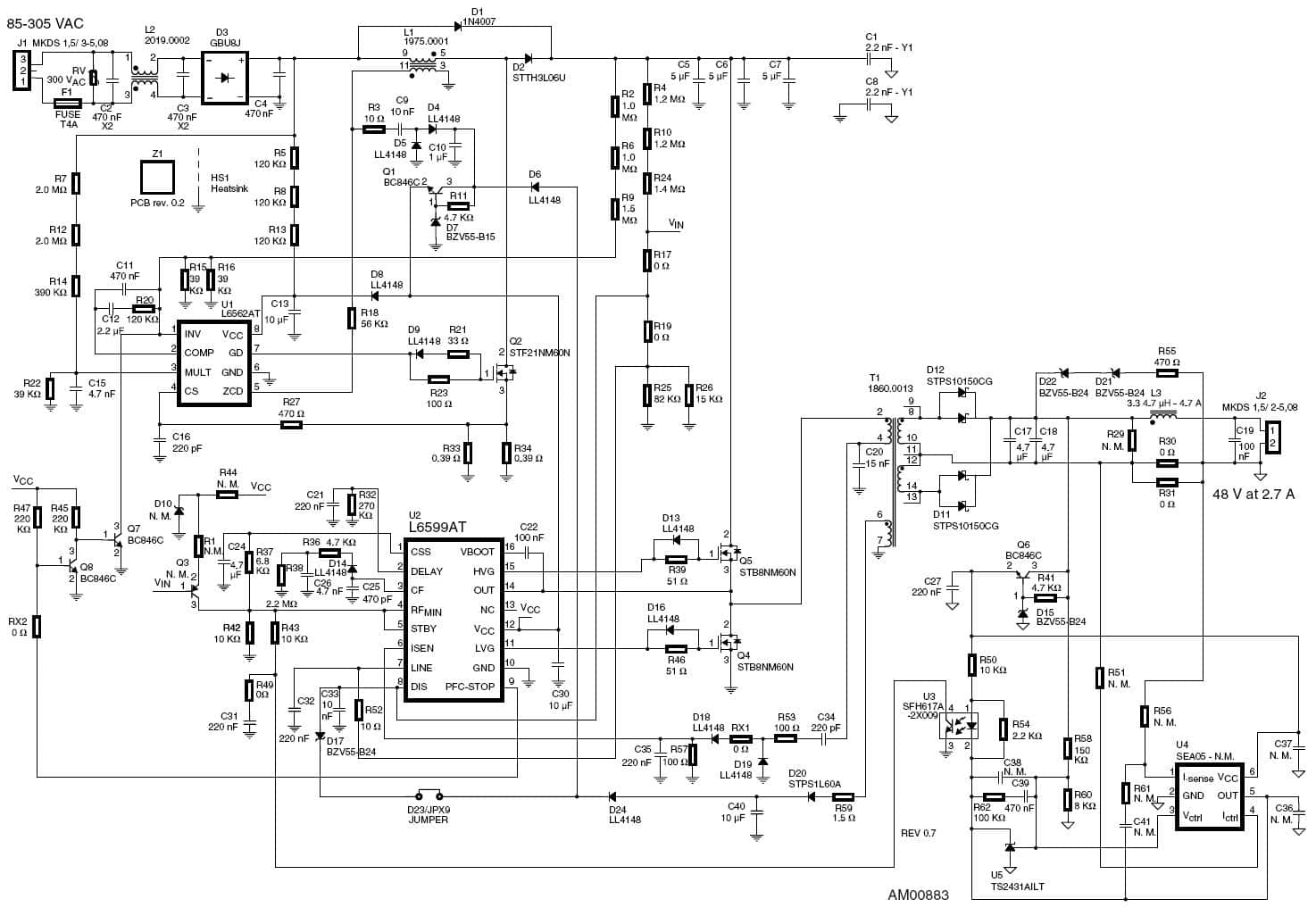
Whenever a lighting application, such as street lighting for example, requires an elevated number of LEDs, there are basically two solutions: the first is to connect all the diodes in series in a single "string"; the second is to place several strings in parallel with fewer elements in each one.
This design was developed to minimize the current spikes coming out of an electronic transformer to less than 5A, which is a typical transformer rating, when driving an LED MR16 circuit. The off the shelf LED MR16 solutions exhibit spikes that significantly exceed a transformers maximum rated output current which will degrade the reliability of the transformer and reduce its operating lifetime. T…
Demonstration circuit 1160 is a full-featured LED driver with 2.3A switch current featuring the LT®3518. The board is optimized to drive a 330mA LED string with a total LED voltage between the input voltage and 40V in a boost topology. The high input voltage range, high efficiency low side internal 2.3A NPN power switch, low voltage floating current sense amplifier, soft-start, high side PMOS PWM…
* The eval board must be modified for 350mA output. The Transformer/Dual inductor and sense resistor(s). This circuit is intended for driving high power LEDs, such as the Cree XLAMP™ series, Lumileds Luxeon™ Rebel and K2 and OSRAM, Golden and Platinum Dragon™ as well as the OSTAR™.
This evaluation board is designed around an L6902D-based DC-DC converter with dimming interface. The board implements both of two well known dimming methods: - Analog current control - Average current control by PWM
This application note presents a low-cost driver for LEDs that is compatible with TRIAC phase-control dimmers. The design gives luminaire manufacturers a low-cost, commonly available dimming option for home fixtures. A side benefit is that, when not wired to a dimmer, the unit's power factor is over 0.9. The design is based on the L6562A transitionmode PFC controller driving a single stage PFC-fl…
Co-Browse
En utilisant la fonction Co-Browse, vous acceptez de permettre à un représentant du support de DigiKey de visualiser votre navigateur à distance. Lorsque la fenêtre Co-Browse s'ouvre, donnez au représentant l'ID de session qui se trouve dans la barre d'outils.
DigiKey respecte votre droit à la vie privée. Pour plus d'informations, veuillez consulter notre Avis de confidentialité et notre Avis relatif aux cookies.
Oui, continuer avec Co-Browse
Merci.
Gardez un œil sur votre boîte de réception pour être informé des dernières nouvelles et mises à jour de DigiKey !
Veuillez entrer une adresse e-mail
Veuillez cocher la case