Digi-key logo
scheme-it logo
Home
Design
BOM
Logout My Account
What’s New DigiKey Tech Forum Keyboard Shortcuts Contact Us Page Help Page Feedback
Scheme It settings
Auto save
Scheme It
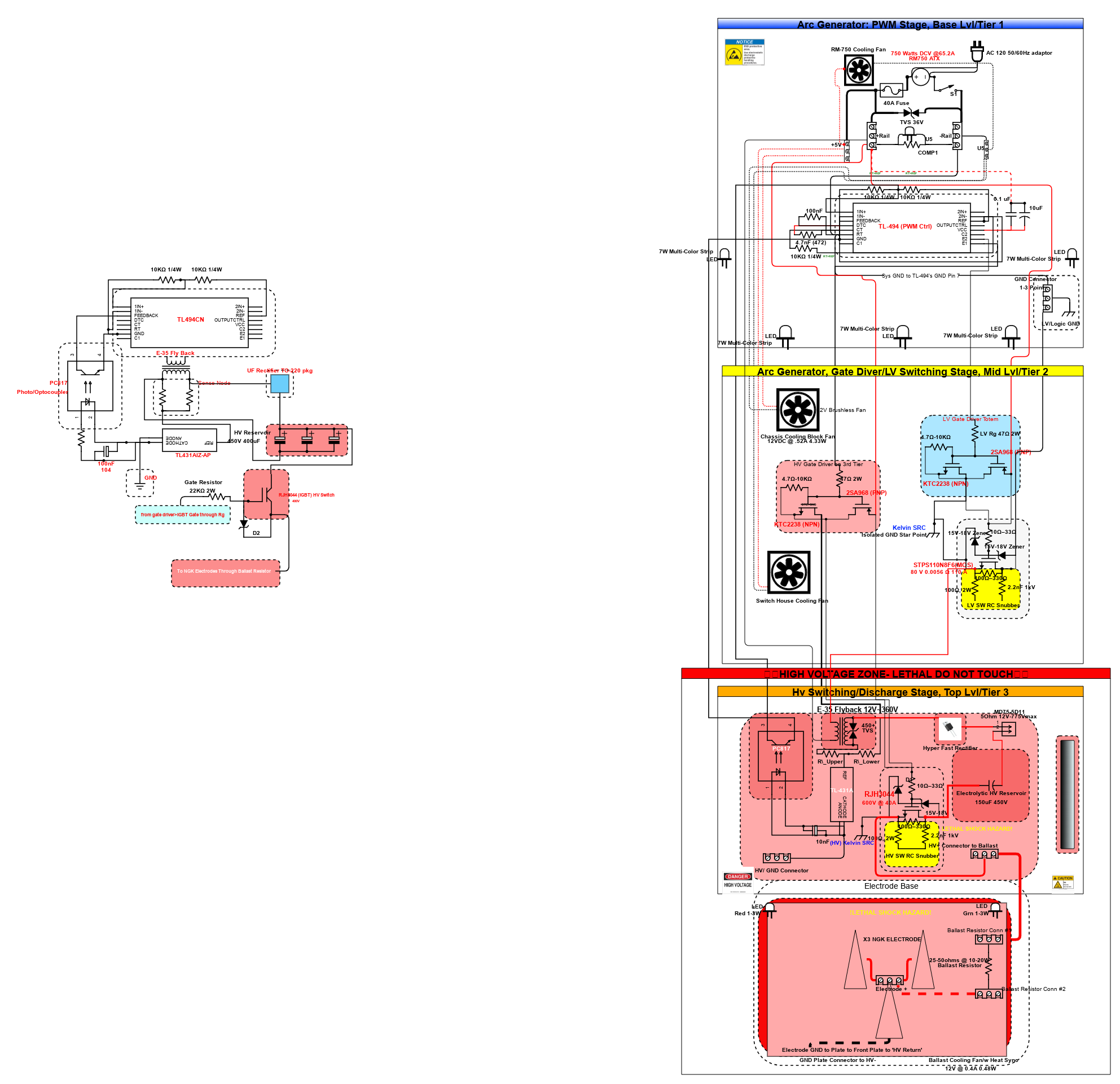
Arc Generator
Arc Generator

Arc Generator


  • Cap voltage barely sags

  • Peak current high and instantaneous

  • Plasma forms but does not fully expand

  • MOSFET stays in switching-dominant regime (low heat)

  • Electrodes see minimal thermal load per pulse

Behavior

  • Sharp “impact” character

  • Distinct, snappy, discrete hits

  • No lingering arc

  • Sound profile: crisp crack, no sustain

Use when

  • You want maximum control over thermal load

  • You want clearly separated pulses

  • You want strong per-event effects without continuous heating

This is the high-peak-power, low-average-power mode.


2. Longer pulses (hundreds of µs → few ms)

Electrical reality

  • Cap voltage drops substantially within the pulse

  • Arc becomes fully established

  • Plasma column expands

  • MOSFET is in conduction regime (major heating)

  • Electrodes accumulate thermal load rapidly

Behavior

  • Looks and sounds like a short “burst” or mini-arc

  • More luminous, more sustained plasma

  • Per-pulse energy feels heavier and more massive

  • Not as “snappy,” more “burn-like”

Use when

  • You want visibly sustained events

  • Peak power is less important than overall arc duration

  • You accept higher thermal load per pulse

This is the lower-peak-power, higher-average-power mode.


3. Repetition rate determines how events stack over time

Low repetition rate (<1–3 Hz)

  • Each pulse is isolated

  • System resets thermally

  • You only care about single-pulse behavior

  • Mechanical/audible events are totally distinct

Use for: single shots, demonstrations, high-energy hits without cumulative heating.


Moderate repetition (5–30 Hz)

  • Feels rhythmic: “ticks,” “strobe”

  • Average heating becomes relevant

  • Component temperature ramps over time

  • Pulses remain distinguishable

Use for: stable repetitive operation where events need to be counted or perceived individually.


High repetition (50–200+ Hz)

  • Individual pulses blur together

  • Acoustic signature becomes buzzing or continuous

  • Average power dominates everything

  • Thermal limits become the governing constraint

  • Discharge may transition into quasi-continuous arc behavior if pulse width is long enough

Use for: continuous-effect systems, but requires tight thermal management.


4. The 3D design space is real and fundamental

Think of operation as a coordinate:

  • X-axis = pulse width (short → long)

  • Y-axis = repetition rate (low → high)

Each region behaves like:

Bottom-left: short, low-rate

  • Max peak impact

  • Zero cumulative heating

  • Sharp, isolated events

Top-left: short, high-rate

  • Buzzing, strobing

  • Peak power preserved

  • Average heating rises sharply

Bottom-right: long, low-rate

  • Heavy, dense, slow pulses

  • Full plasma events with time to cool

  • High per-pulse thermal load but safe average

Top-right: long, high-rate

  • Nearly continuous discharge

  • Arc-like behavior

  • Thermal limits dominate

  • Highest component/electrode stress

This grid is the actual map you’re working inside.


5. Practical way to choose operating point

Define three things:

  1. Character of a single pulse
    Sharp hit vs sustained burst

  2. How the sequence should feel over time
    Isolated vs strobing vs continuous

  3. How much thermal budget you’re willing to spend
    Low vs moderate vs high average load

Once those factors are chosen, the pulse width and repetition rate fall out automatically.

Read more
Open Design

Incorporated Products

IMAGE
MANUFACTURER PART NUMBER
DESCRIPTION
QUANTITY
VIEW DETAILS
1
SQZ5W220RJL001
Cement Res SQZ 5W 220ohm 5%
20
View Details
2
CF14JT1K00
RES 1K OHM 5% 1/4W AXIAL
4
View Details
3
TL494BDR2G
IC REG CTRLR BCK/PSH-PULL 16SOIC
2
View Details
4
PC817X2NIP0F
OPTOISOLATOR 5KV 1CH TRANS 4-SMD
2
View Details
5
FES6D
6A 400V ULTRA FAST RECTIFIER
1
View Details
6
CML474M50
CAP CER 0.47UF 50V Z5U RADIAL
1
View Details
7
AVS106M63D16B-F
CAP ALUM 10UF 20% 63V SMD
1
View Details
8
TL431AIZ-AP
IC VREF SHUNT ADJ 1% TO92-3
2
View Details
9
ICL 22 OHM 25%
1
View Details
10
MUR560
TO-220AC 600V 5A Diodes Rectif
1
View Details
11
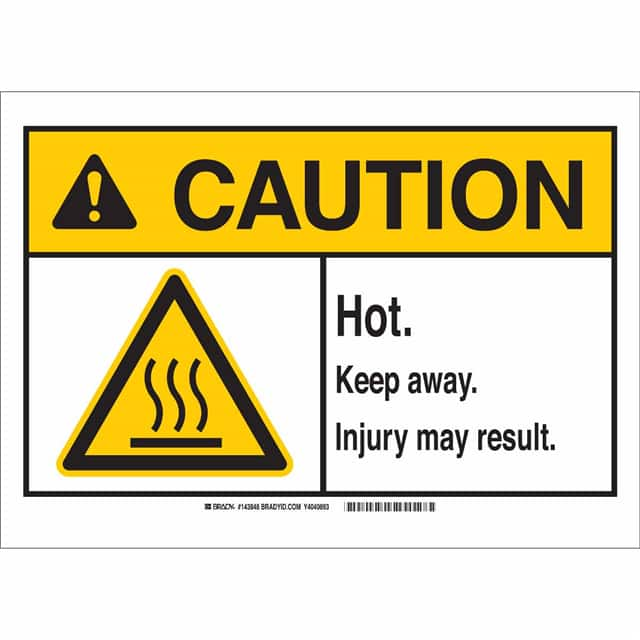
143848
B302 10X14 ANSI BLK,YEL/WHT HOT
1
View Details
12
SP400D
B401 10X14, RED/BLK, HIGH VOLTAG
1
View Details
13
FM130-MPSW3
NOTICE 12" X 18" ,FLOOR DECAL
1
View Details
14
RM-750
DC INDEPENDENT, VERTICAL
1
View Details
15
1B2214C320
1
View Details
SQZ5W220RJL001
Cement Res SQZ 5W 220ohm 5%
Quantity: 20
View Details
CF14JT1K00
RES 1K OHM 5% 1/4W AXIAL
Quantity: 4
View Details
TL494BDR2G
IC REG CTRLR BCK/PSH-PULL 16SOIC
Quantity: 2
View Details
PC817X2NIP0F
OPTOISOLATOR 5KV 1CH TRANS 4-SMD
Quantity: 2
View Details
FES6D
6A 400V ULTRA FAST RECTIFIER
Quantity: 1
View Details
CML474M50
CAP CER 0.47UF 50V Z5U RADIAL
Quantity: 1
View Details
AVS106M63D16B-F
CAP ALUM 10UF 20% 63V SMD
Quantity: 1
View Details
TL431AIZ-AP
IC VREF SHUNT ADJ 1% TO92-3
Quantity: 2
View Details
ICL 22 OHM 25%
Quantity: 1
View Details
MUR560
TO-220AC 600V 5A Diodes Rectif
Quantity: 1
View Details
143848
B302 10X14 ANSI BLK,YEL/WHT HOT
Quantity: 1
View Details
SP400D
B401 10X14, RED/BLK, HIGH VOLTAG
Quantity: 1
View Details
FM130-MPSW3
NOTICE 12" X 18" ,FLOOR DECAL
Quantity: 1
View Details
RM-750
DC INDEPENDENT, VERTICAL
Quantity: 1
View Details
1B2214C320
Quantity: 1
View Details

About this Schematic

Created By
Andrew Canale
Last Updated
2026-02-04 10:18
What’s New
You are about to delete project

Please type 'DELETE' (without quotes) to the below box to confirm the deletion:
  • Introduction
  • Tutorial Videos
  • Homepage
  • Revision
  • Symbol Editor
  • KiCad Export(beta)
  • Favorite symbols
  • Net
  • Save/Open/Delete Projects
  • Autosave and History
  • Placing Symbols
  • Wiring Symbols
  • Adding/Editing Text
  • Math box
  • Share and Export
  • BOM Manager
  • DigiKey Catalog
  • FAQ
Title